Download Ebook Systems Thinking, Systems Practice: Includes a 30-Year Retrospective
Also the rate of an e-book Systems Thinking, Systems Practice: Includes A 30-Year Retrospective is so economical; several individuals are really stingy to allot their cash to get the publications. The other reasons are that they really feel bad and also have no time at all to visit the e-book store to browse the book Systems Thinking, Systems Practice: Includes A 30-Year Retrospective to read. Well, this is modern era; so lots of books could be got easily. As this Systems Thinking, Systems Practice: Includes A 30-Year Retrospective as well as a lot more e-books, they can be entered really quick methods. You will not should go outside to obtain this publication Systems Thinking, Systems Practice: Includes A 30-Year Retrospective
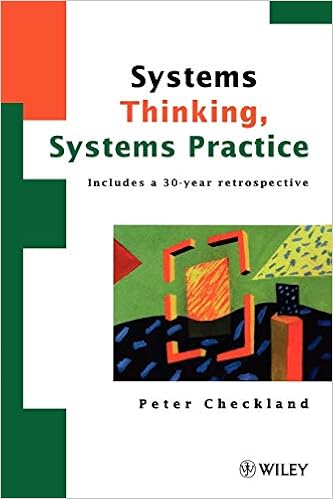
Systems Thinking, Systems Practice: Includes a 30-Year Retrospective

Download Ebook Systems Thinking, Systems Practice: Includes a 30-Year Retrospective
Systems Thinking, Systems Practice: Includes A 30-Year Retrospective. Is this your extra time? Just what will you do then? Having spare or spare time is really incredible. You can do everything without force. Well, we intend you to save you few time to read this publication Systems Thinking, Systems Practice: Includes A 30-Year Retrospective This is a god publication to accompany you in this leisure time. You will not be so tough to know something from this publication Systems Thinking, Systems Practice: Includes A 30-Year Retrospective Much more, it will certainly help you to obtain far better details and experience. Also you are having the great tasks, reading this e-book Systems Thinking, Systems Practice: Includes A 30-Year Retrospective will not add your mind.
If a publication from popular author exists, at some time lots of followers of them will straight acquire the book. Also any book kinds, however are they actually checking out guide? That recognizes? Hence, we will show you a publication by familiar author entitled Systems Thinking, Systems Practice: Includes A 30-Year Retrospective This publication will provide you some benefits if you really read it. The very first is you could obtain the new words as exactly what we have not known about it formerly. We can likewise boost the international language from reading this publication. There are any.
From the title, we will also show you the topic pertaining to describe. When you actually require this type of source, why don't you take it currently? This book will certainly not only provide you the understanding as well as lesson regarding the topic, from the words that are used, it define brand-new fun thing. This Systems Thinking, Systems Practice: Includes A 30-Year Retrospective will make you really feel no fear to invest more time in analysis.
Now, when you need a brand-new pal to accompany you encountering and also addressing the difficulties, Systems Thinking, Systems Practice: Includes A 30-Year Retrospective is the prospect to advise. It could accompany you wherever you go advertisement you require. It's developed for soft file, so you will not feel hard to locate as well as open it. Juts open up the tab and afterwards read it. In this manner can be done certainly after you are getting the papers using this website. So, your job is by clicking the web link of that publication to go to.
Systems Thinking, Systems Practice "Whether by design, accident or merely synchronicity, Checkland appears to have developed a habit of writing seminal publications near the start of each decade which establish the basis and framework for systems methodology research for that decade." Hamish Rennie, Journal of the Operational Research Society, 1992 Thirty years ago Peter Checkland set out to test whether the Systems Engineering (SE) approach, highly successful in technical problems, could be used by managers coping with the unfolding complexities of organizational life. The straightforward transfer of SE to the broader situations of management was not possible, but by insisting on a combination of systems thinking strongly linked to real-world practice Checkland and his collaborators developed an alternative approach - Soft Systems Methodology (SSM) - which enables managers of all kinds and at any level to deal with the subtleties and confusions of the situations they face. This work established the now accepted distinction between 'hard' systems thinking, in which parts of the world are taken to be 'systems' which can be 'engineered', and 'soft' systems thinking in which the focus is on making sure the process of inquiry into real-world complexity is itself a system for learning. Systems Thinking, Systems Practice (1981) and Soft Systems Methodology in Action (1990) together with an earlier paper Towards a Systems-based Methodology for Real-World Problem Solving (1972) have long been recognized as classics in the field. Now Peter Checkland has looked back over the three decades of SSM development, brought the account of it up to date, and reflected on the whole evolutionary process which has produced a mature SSM. SSM: A 30-Year Retrospective, here included with Systems Thinking, Systems Practice closes a chapter on what is undoubtedly the most significant single research programme on the use of systems ideas in problem solving. Now retired from full-time university work, Peter Checkland continues his research as a Leverhulme Emeritus Fellow.
Your recently viewed items and featured recommendations
›
View or edit your browsing history
After viewing product detail pages, look here to find an easy way to navigate back to pages you are interested in.
Product details
Paperback: 424 pages
Publisher: Wiley; 1 edition (September 16, 1999)
Language: English
ISBN-10: 9780471986065
ISBN-13: 978-0471986065
ASIN: 0471986062
Product Dimensions:
6 x 0.9 x 9.1 inches
Shipping Weight: 1.6 pounds (View shipping rates and policies)
Average Customer Review:
4.0 out of 5 stars
10 customer reviews
Amazon Best Sellers Rank:
#869,067 in Books (See Top 100 in Books)
Basically, the soft systems methodology (SSM) can in effect facilitate the incremental re-engineering of human activity systems without an explicit reverse engineering phase. Such systems are called soft because they present persistently ill-formed problem situations, largely due to their inherent complexity and contingent behavior. These attributes are typically characterized by the lack of consistently repeatable behaviors/outcomes. In particular, they exhibit nondeterminism (due to variabilities of various human agents and their institutions) as well as nonstationarity (per sporadic changes in their makeups and circumstances). Such dynamism of agendas and situations, moreover, serves to vastly complicate the static complexity of human organizations and society. In consequence, their inherent intractability results in the futility of positivist schemes for analyzing or improving them. Accordingly, the SSM or similar approaches are vital in effectively exploring such systems, as well as in incrementally improving them.Checkland and his associates originally attempted to apply typical systems engineering methods in dealing with human activity systems, but soon recognized their unsuitability for dealing with the ill-formed problem situations as endemic to human activities. Similarly, they found general systems theory had nothing of value to offer. They then gravitated to the inquiry system concept espoused by Singer/Churchman as a means of systematically investigating and improving human activities, which the SSM characterizes in its Real World Domain. Complementary systems thinking is performed in a corresponding SSM Systems Thinking Domain. These two SSM partitions together constitute the inquiry system, which can be traversed iteratively to serve as a learning system regarding a target human activity system. The SSM focuses and prompts the learning process, which enables incremental improvements in the targeted system. Conceptually, the SSM is composed of the following seven elements:1. Perceiving - the Problem Situation2. Formulating - the Focal Issues Perspective3. Composing - the Root Definition (of the selected system aspects)4. Predicating - the Conceptual Models5. Comparing - Conceptual Models with the Focal Issues Perspective6. Deciding - Desirable/Feasible Changes7. Activating - Changes to Problem Situation.Elements 3 and 4 reside in the Systems Thinking Domain, and are referred to as Mode 2 or interpretive steps of the SSM. The other elements occur in the Real World Domain, and they are termed Mode 1 or intervention steps. The iterative looping through all seven steps realizes a Singerian inquiry system, which is intended to yield an increasingly accurate characterization of the human activity system’s problem situation. A defined template for the root definition in Element 3 serves as the basis for the conceptual models. They are composed in Element 4 of (nebulous) ideal types of generic elements, as tailored for human activity systems in general. Next, the SSM process tends to ameliorate selected undesirable aspects of the problem situation. Here, judgments regarding the comparative discrepancies between actual and ideal system attributes rely on the use of an adaptation of Vickers’ appreciative system in Element 5, as do decisions regarding remedial options in Element 6. Promising system changes are then introduced in Element 7.In the book’s systems thinking portion (approximately the first 40 per cent), I found the content to be a quite interesting and palatable background survey. However, there seems to be no incisive definition of systems thinking, one that is precise, coherent, and declarative. Various examples and fragmentary rationale do not suffice, especially in view of its broad range of interpretations and applications appearing in the literature at large. Consequently, my impression of systems thinking is that of a catch-all collection of disparate notions and techniques compiled via breadthwise importation of assets of plausible or speculative worth. Systems thinking thus seems to be a sketchy high-level concept whose inherent vagueness and ambiguity can sometimes be exploited opportunistically. In particular, a systems practitioner can morph it into whatever configuration that incident circumstances may suggest. Alas, I remain quite unclear as to what in essence constitutes systems thinking per se; other authors, moreover, reinforce my perplexity.In the systems practice portion of the book, my view of SSM is largely favorable. For example, SSM could support the conjoined exploration of related problem and solution spaces. In general, moreover, I believe that the SSM architecture has considerable promise for such use in engineered physical systems, especially software-based ones. (In my experience, such systems invariably manifest some aspects of soft systems.) An SSM-type approach might for example be valuable when investigating upgrades to an existing engineered system that is poorly structured or documented. Alternatively, the SSM inquiry capability might be used when an existing system is possibly going to be used for different functions, or in different environments. Of course, it would seem that the SSM’s utility for soft systems is beyond dispute, with only a few reservations. Although they would all seem tractable to resolution, my main concerns are:1. the modest scale/depth and large number of problem situations addressed, given the limited time and staffing applied, can hardly suffice to demonstrate ample conclusiveness2. no treatment of certain major concerns for ill-structured human activity systems is presented: nondeterminism, nonstationarity, indefinite boundaries, change side effects, for example3. the utilization of Vickers’ appreciative system concept seems glib and oblique4. by definition holons are elements in a particular form of level structure called a holarchy; an activity level, however, is erroneously conflated with activity flow in SSM.In his thirty-year retrospective, Checkland makes two comments that I found disconcerting. First, he says that the above seven-step SSM process has been simplified to four steps. The seven-step version is already sketchy enough, and it seems that SSM is now devolving to the status of lore. Then, he notes that the handmade diagrams, as contrasted with ones that might be constructed and supported with a drawing tool, are preferable in conveying the provisional stage of their formulation. For many reasons, these handmade drawings would definitely be an impediment to the practical full-scale use of SSM, for clients and systems practitioners alike.Aside from my reservations about the lack of closure of systems thinking coverage in this book, I consider the SSM concept to be quite intriguing and promising overall. Disconcertingly though, there appear to be surprisingly few follow-up publications in recent years that extend of further elaborate SSM. This might in part be attributable to the (apparent) lack of an integrated SSM environment. In any case, SSM would seem to merit further implementation development, especially in that at present it appears to essentially be just an architecture of a methodology, albeit one usable for manual application. Despite the definite appeal of the SSM concept, however, my appreciative system scores the book at only Four Stars.
What is really going on here? If we look solely at the 'problem' we may miss the true picture. Soft Systems thinking, at its core, asks us to see anew, to identify and understand the many variables affecting a situation, process, or operation including our biases and assumptions. In part, this book was written to clearly distinguish hard from soft systems thinking. The original seven stages of soft systems thinking included 1.Entering the problem situation; 2. Expressing the problem situation; 3.Formulating root definitions of relevant systems; 4.Building Conceptual Models of Human Activity Systems; 5.Comparing the models with the real world; 6.Defining changes that are desirable and feasible; and 7.Taking action to improve the real world situation.; and Rather than a linear process, soft systems thinking is an iterative, dialogical process.In the retrospective included in this version - the four activities included: 1) finding out about a problem situation; 2) formulating relevant purposeful activity models; 3) debating the situation seeking both changes that would improve the situation and the accommodations between conflicting interests; and 4) taking action (p. A15).This book is worth its weight for the 30 year retrospective on systems thinking - a wonderful historical summary! An excellent bibliography on systems thinking is also provided!
Useful for my work
This book was recommended by a friend with Systems Engineering expertise, and has become one of my favorite books on the subject.A good balance of humor and serious dialog is maintained.Complete, crisp, and clean descriptions of the many approaches to Systems Theory are discussed and well delineated.An excellent book for all ranges of background and purposes, I highly recommend it as a beginning point or a refresher course.
I had been reading his work for 25 years, this is an exceelent update after all the years. To be recommended to all!
Wordy...unclear...I have to read & organize too much in order to make use of the valuable content.
Systems Thinking, Systems Practice: Includes a 30-Year Retrospective PDF
Systems Thinking, Systems Practice: Includes a 30-Year Retrospective EPub
Systems Thinking, Systems Practice: Includes a 30-Year Retrospective Doc
Systems Thinking, Systems Practice: Includes a 30-Year Retrospective iBooks
Systems Thinking, Systems Practice: Includes a 30-Year Retrospective rtf
Systems Thinking, Systems Practice: Includes a 30-Year Retrospective Mobipocket
Systems Thinking, Systems Practice: Includes a 30-Year Retrospective Kindle